John Black and Associates
  • About Us
    • JBA Team
    • History
    • Blog
    • Press
  • Our Services
    • Healthcare Transformation
    • Tours
    • 3P Lean Design
    • Mistake Proofing Webinar
  • Clients
    • Results
  • Books
    • Articles
  • Contact Us

Process Makes Perfect at World-Class Organizations

12/9/2016

 
​In many ways, the healthcare and manufactuing industries seem at odds. Healthcare is about healing people. Manufacturing is about processing materials. But my mission has been to bridge the gap, to prove that delivering the best healthcare relies on the processes you have in place—the processes that create the flow of patients, family, providers, medicines, supplies, equipment, and information.
 
Bottom line: Cut down your time getting everything in place, and you increase face time with patients.
 
World-class healthcare organizations understand this principle. They think of their processes as a strategic weapon—The Big Gun.
 
What does that mean?  The best healthcare. The least waste. The lowest price. The shortest time.  Right the first time. Processes are valued as core competencies.
 
Kanban, a way of automatically signaling when new parts, supplies, or services are needed, is essential to transforming hospital operations. If supplies aren’t in their correct place when they’re needed, you jeopardize patient safety. At the same time, oversupply leads to wasted space and inventory. When I was in the Saskatchewan province in Canada, I watched the Five Hills Health region design their kanban process the right way, working and re-working the system:
​World-class organizations search relentlessly for ways to reduce waste, reduce cycle time, and reduce inventory. They look constantly at their processes. They search ceaselessly for improvements. They work patiently for small refinements. 
 
During the Japan Study Missions, we noticed that there were more "process engineers" in the world-class factories we visited then we'd seen at other companies. These process engineers work on production processes and methods every single day. They know their processes. They take pride in that knowledge. They understand better than anyone else how the production system fits together, how the factory machinery operates in the process, what they want the process to do, and how important it is to find better ways.  Processes are not just studied—they are aggressively scrutinized and regularly improved. 
 
Do you know what one process engineer told us during our visit to his factory in Japan?  He told us that the manufacturing equipment is in the worst shape it will ever be in on the day it is delivered new from the supplier!
 
Healthcare organizations need people with the same kind of process focus, people whose primary responsibility is to improve the processes that can improve the care. Leaders are also essential to continuously improving process. Lean leaders need to be on the front lines, seeking improvements at every level of operation.
Picture
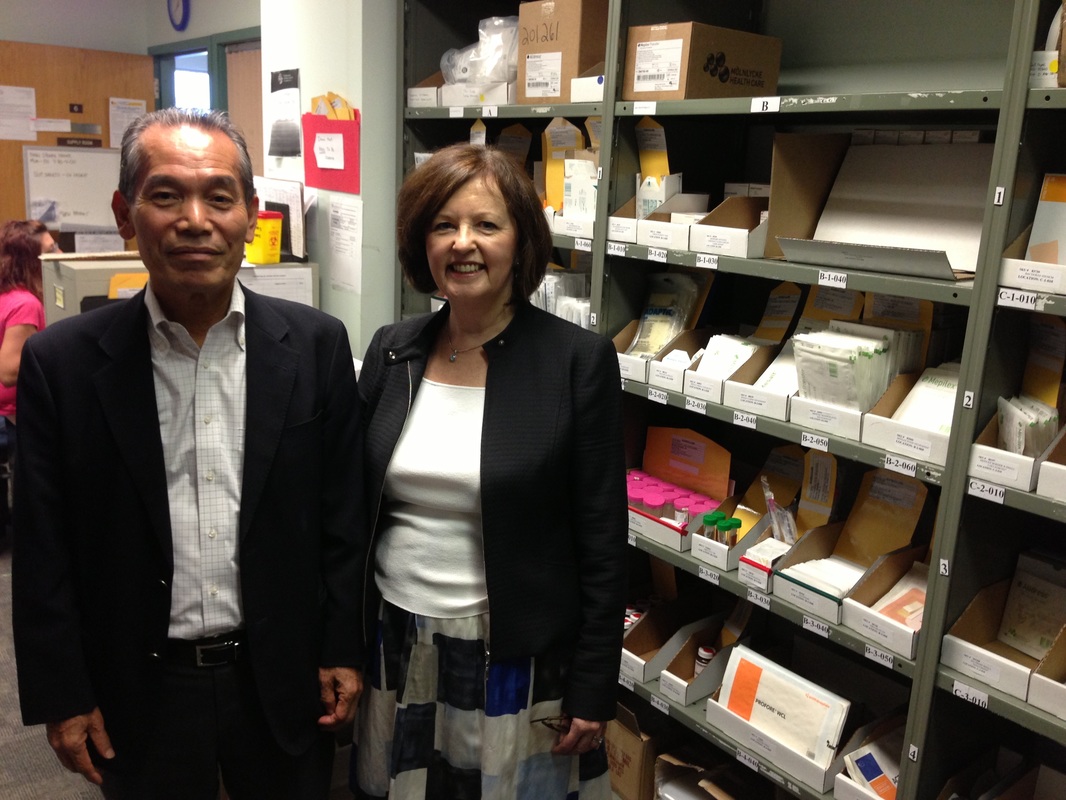
​Here’s Maura Davies, former CEO of the Saskatoon region in Saskatchewan, Canada, implementing kanban at Home Health under the expertise of Sensei Narita. She’s a great example of what it takes to achieve the promises of the Toyota Production System. She’s not in her office. She’s on the front line, getting involved in improving the process, piece by piece.

Patient Focus Enhances Quality of Care

12/2/2016

 
​World-class healthcare organizations have an intense patient focus.
 
Talk is not enough.  "Patient focus" is more than just a pleasant slogan.
 
World-class healthcare organizations are redefining the idea of patient focus.  They know that true patient focus is not passive—it is active, aggressive, passionate, fervent, energetic, and tireless. You must have an unconditional commitment to your patients.
 
The patient is not just involved in the process—the patient is an indispensable part of the process, and it doesn’t work without the patient's involvement. Care cannot be delivered or innovated in a vacuum.
 
This means inviting patients into their care.  This means pursuing what the patient wants—chasing down what they need both in terms of medical care and in terms of the atmosphere, logistical processes, and family support that may be involved—until you get it right. It also means leaving behind attitudes such as, “That’s the way we have to do it,” and “Look, this is how we do it around here,” or worse yet, “Patients may not like it, but it works better for the doctors or staff this way.”
​World-class organizations have realized that success happens when they center operations on patient needs. What do I mean? I mean you no longer have to make educated guesses about patient expectations. You just ask the patient. Then you shut up and listen.
 
The best intentions in the world mean nothing if your patient isn't satisfied with and impressed with his care.  Patient satisfaction is the key measure of performance.
This focus on patient satisfaction does not compromise medical care or organizational efficiency. It enhances both.
 
Patients are at your doorstep because they need your help. They are hurting. They are going through medical crises they can’t solve on their own. But at the end of the day, you have to believe that the patient ultimately knows what is best for them. The patient — and sometimes, their loved ones — can and should collaborate with you on their care.
 
How are the best organizations focusing on their patients? First, they include the patient in the process of collecting information about his needs and expectations. Next, healthcare professionals analyze what that information means and learn to understand it in the context of the medical situation and care environment. Then, they implement the results by creating the care plan that best meets patient expectations, needs, and preferences. Finally, they measure patient satisfaction, including the medical, emotional, and logistical aspects of their care. From start to finish, the approach is true patient focus.
 
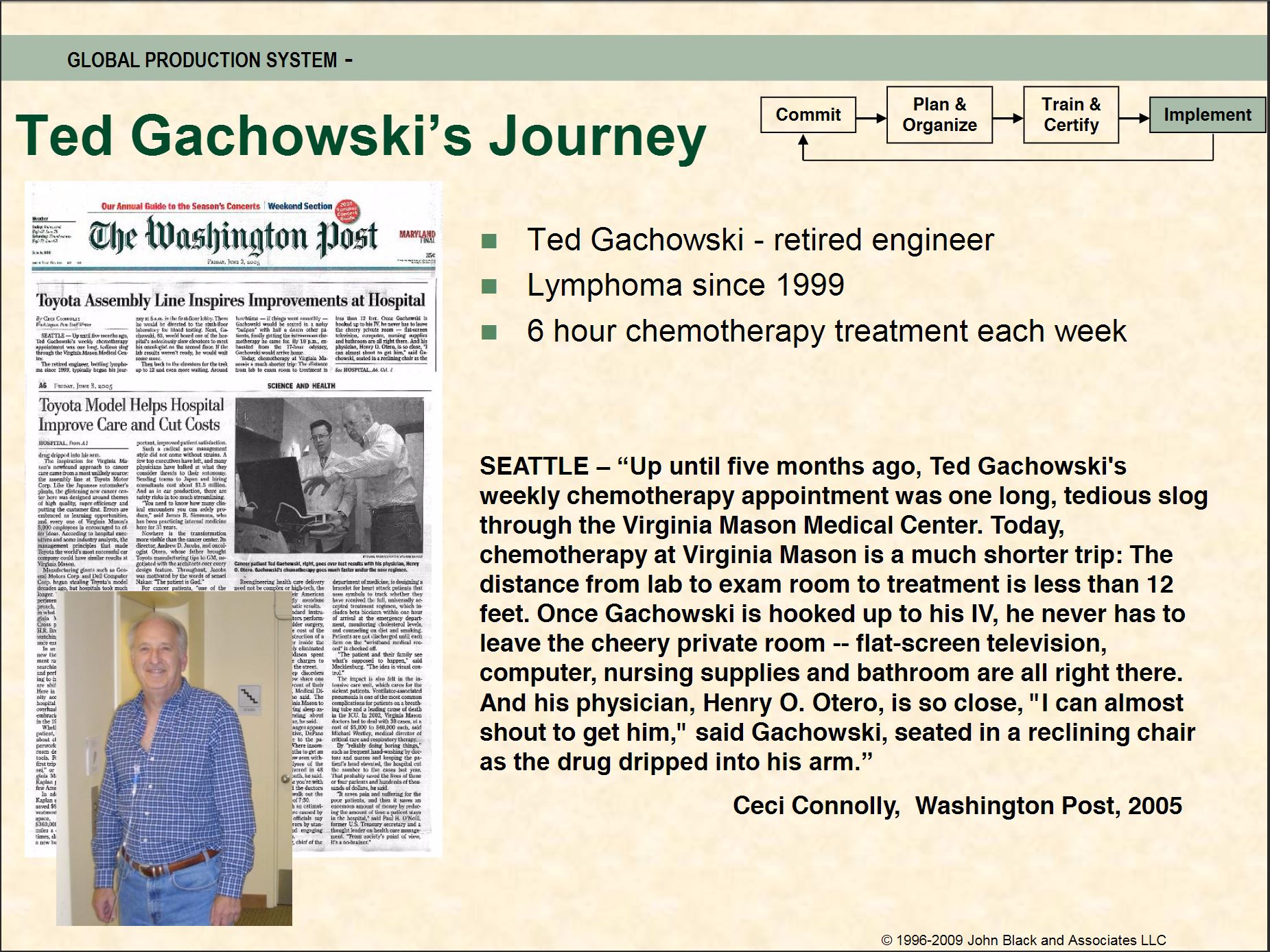
When world-class Lean leaders focus on their patients, they achieve real results. They put patient input into action. Take a look at the experience of Ted Gachowski, a patient at Virginia Mason when JBA was consulting there.
Picture
​I highlighted Ted’s case and the leadership of his doctor in the second edition of my book:
Every week, a patient suffering from lymphoma had to make a three-hour drive from his home to receive a six-hour chemotherapy treatment. The travel and treatment was worse than the disease, at least initially. Because of the travel and treatment time, he stayed overnight in Seattle
​Ted’s physician, Dr. Henry Otero, saw the needless difficulties created by the treatments that were supposed to be helping Ted feel better. Otero galvanized the hospital staff to find solutions, and greatly improved the quality of Ted’s care.
The staff listened to the patient’s needs and went to work to cut his treatment time at the hospital. They cut his time at the hospital by 2 hours and 40 minutes (25 percent), his lead time by 2 hours and 30 minutes (63 percent), his in-hospital travel distance by 567 feet (76 percent), and his non-value-added time in the hospital by 142 minutes (73 percent). Bottom line, instead of checking in at 8 a.m. and completing his treatment at 6:25 p.m., he checked in at 8 a.m. and left the hospital at 3:45 p.m

​Patient focus, front and center, put into action by Dr. Henry Otero, a world class leader who gets it.


If you missed it, be sure to check out my first post on world-class healthcare organizations here.

Achieving World-class Healthcare

11/25/2016

 
Today on the blog, I’m going to lay out a vision for elevating your organization to a world-class level so you can achieve excellent, effective patient care on time and on budget.
 
There’s two keys to becoming the best in the business: your people’s passion and your commitment to continuous improvement.
 
World-class organizations know how to harness these keys to success—world-class organizations know how to aggressively focus human potential to excel far beyond all known or imagined standards of performance.
 
Let’s break down that statement. 
​Focusing human potential
 
People are your most potent resource. No machine can match the human mind’s ability to innovate. No machine can match the compassion your people bring to patient care.
Picture
During this 3P event in the Five Hills Health region in Saskatchewan, JBA galvanized key stakeholders to achieve a 40% more efficient flow than current best practices, showcasing the dramatic effects of focusing brainpower to find innovative solutions.
​World-class companies really go after all that their people have to offer. They tap into the intellectual, physical, spiritual and emotional strengths of their employees. They consciously and energetically depend on their nurses and doctors to innovate the best care delivery possible. They understand and believe absolutely in the value of their people.
 
Your staff chose healthcare because they are deeply committed to serving others. World-class organizations amplify their employees’ passion for patient care by investing back into their people. Education and training levels are kept high—they are a planned, significant part of each worker's year.  Actions and policies—not just talk—reflect the value placed on people by world-class companies.
 
 
Excelling beyond known or imagined standards
 
To excel far beyond all known or imagined standards of performance.  This statement has two parts. First: “to excel far beyond.” Not just meet, exceed, or improve upon—but to completely and emphatically surpass those standards. This means committing to continuously improve, even after you’ve met your original goals.
Picture
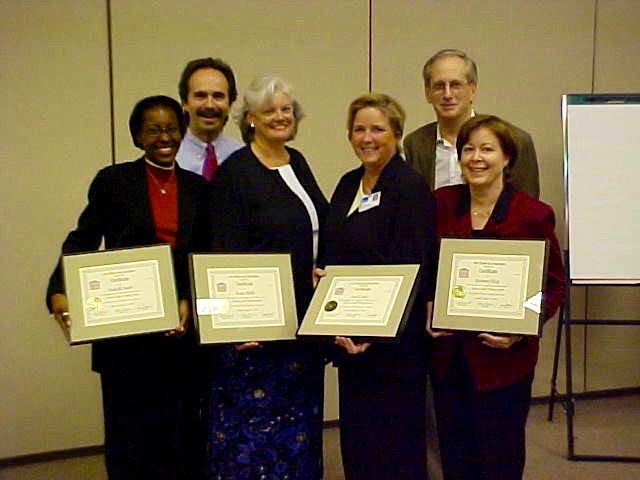
Mike Rona, President of Virginia Mason Medical Center, and I present certificates to the first group of Lean leaders at VMMC. Implementing the Toyota Production System shattered known standards of excellence at VMMC and ushered in a new era of quality care.
Second: “all known or imagined standards.”  World-class organizations don't just excel relative to established standards.  They defy our imaginations with their performance.  They don't just perform far better than what we know. They outperform the best we've imagined!
 
That means quality increases by factors of 100—or 1000. Cutting costs in half.  Five times as many patients seen in the same facility—or ten times as many!  Reducing supplies inventory by 90%. Doubling productivity—then doubling it again!  Lead times reduced by a factor of 5 to 10. Cutting new product, service, and process design lead times in half.
 
Amazing, dramatic, impressive improvements—completely shattering all previous, current, or imagined standards. Again, this means supporting innovative improvements even after you achieve your original goal. Stagnancy leads to financial instability and under-performance in care quality. Don’t stop, keeping evolving. Your results will keep evolving, too.
 
Finally, world-class organizations excel in all aspects of performance. This means all aspects—patient satisfaction, inventory management, care innovations, staff management—you name it.  World-class leaders continuously improve their whole system, never leaving a division behind.
 
Be sure to look out for upcoming posts on the blog. My next series will take a take a closer look at five world-class aspects of performance: customer focus, operations, product deployment, organizational design, and leadership.
​

Listening to the Frontline

11/11/2016

 
In addressing change, leaders have to decide which model they will follow: conflict in which two camps draw battle lines around functional silos; crises in which angry tension exists between functional leaders, doctors, nurses, staff and others; coexistence in which all parties decide not to address differences, to sweep them under the rug and maintain the status quo; collaboration in which everyone agrees to work together to create an organization without waste; cooperation, which is the most positive, where total commitment and openness to the welfare of the people and the organization is seen as paramount to the effort to create an organization without waste.
 
In healthcare, leaders often choose models that do not serve the best interests of their patients and create environments that stymie innovation.
Picture
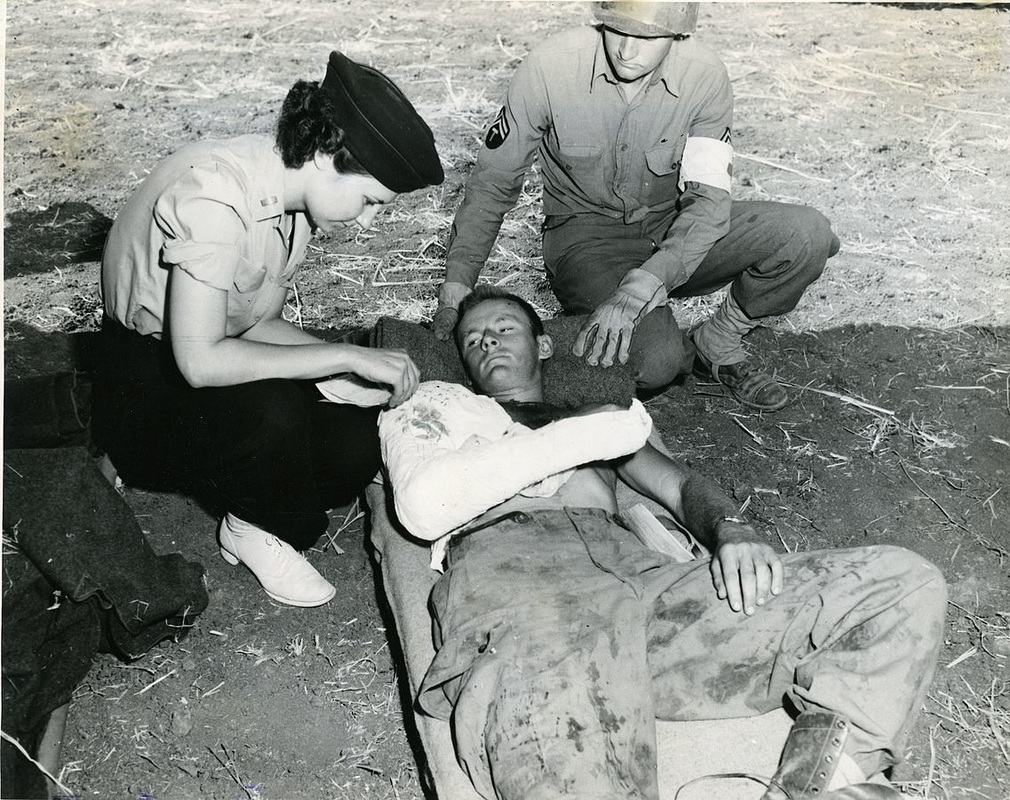
While wartime often sparks technological advances, past military leaders have sometimes blocked the implementation of innovation.
For example, head physicians in the U.S. military during WWII chose to ignore their colleagues’ calls from the frontlines to transition from plasma-only to whole blood transfusions. War is hell. It’s not easy to lead during a war. But had the management culture been more receptive to continuous improvement, battlefield physicians wouldn’t have had to fight so hard to implement life-saving technology.
 
There were several factors that contributed to the use of plasma rather than whole blood for transfusions at the outset of WWII. In the North Africa campaign there was no such thing as a blood bank where whole blood could be refrigerated and stored until it was needed. Then, no one had developed the means to send refrigerated blood to the battlefronts where it was needed. Lastly, physicians believed that plasma was better than whole blood.
 
However, as the war progressed it became clearer to frontline physicians and surgeons that there was a better outcome for severely wounded patients when whole blood was used. In this case the change agent was a physician, Colonel Edward D. Churchill, surgical consultant to the U.S. Army in the Mediterranean theater. The Colonel presented a new medical concept for the treatment of hemorrhage and shock: whole blood.
 
He started lobbying for change and hit several brick walls. He was swimming upstream against a long held notion that plasma was better, contrary to the evidence from battlefield physicians and surgeons. He quickly realized change could not come from within the military system. Even after a U.S. Navy Surgeon (Lieutenant Henry S. Blake) invented a special box to hold and transport refrigerated containers of blood, the Navy’s Surgeon General didn’t think it was that great an idea and refused to have the box used regularly in navy medicine.
 
Blake didn’t give up on his invention, and Churchill took the case for military use of whole blood to the New York Times. The Times wrote an article on August 26, 1943 titled, “Plasma Alone Not Sufficient.” The American public was upset when they read the article, fearful for the lives of its sons at the front. Finally, the U.S. Army Surgeon General felt pressured enough to quickly accept whole blood for Army use on the battlefield.
 
Look, I’ve seen firsthand how well the medical system works and how thousands of soldiers lived because of the expert care and miracles performed by surgeons, physicians and nurses on the battlefield. During my second tour in Vietnam, I was medevac’d back to the states. I was loaded on a string of medevac’d flights starting in Saigon, from Saigon to Guam, overnight then to Hickam Field, Hawaii, five hours parked in the heat on the tarmac because we were all infected, then to San Francisco, VA Medical Center, overnight, then to Madigan General in Tacoma, WA, and hospitalized for 30 days.
Picture
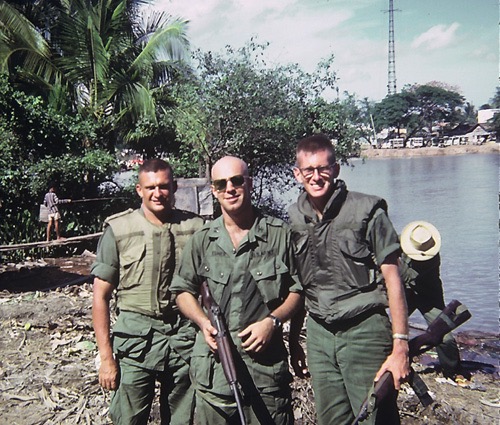
Three U.S. infantry captains crossing the Mekong in 1967. I'm on the right.
I know medicine’s ability to save lives. That’s not the issue. The issue in healthcare today is the same as it was in WWII: creating management cultures that support innovations in care delivery from the frontlines, the doctors and nurses on the floor, saving patients’ lives in our hospitals every day.

"We care for patients, not cars"

11/4/2016

 
​Change can be difficult for some, not for others. It can be a mixed bag of attitudes, opinions, resistance, support when you start talking about the Toyota Production System (TPS) among healthcare leaders at all levels. I’ve gotten comments like, “What do you mean TPS, we care for patients, not cars – or at Boeing when we first started, “What do you mean TPS, we build airplanes.”
 
I’ve been told, “If we bring you in don't use Japanese words or terms, don’t bring in Japanese consultants, don’t start telling us about Toyota, we serve patients, not cars – don't talk about the Toyota Production System.” My comment usually is, “what do you want me to talk about, what do you want?”
Picture
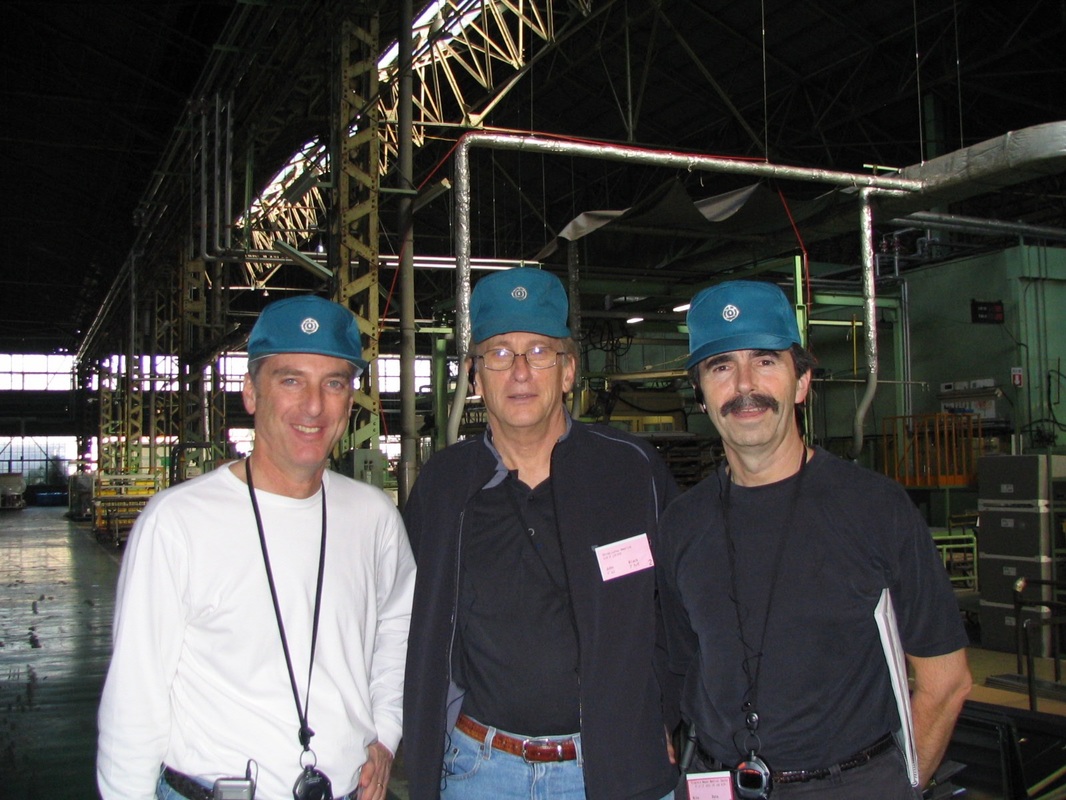
Mike Rona, Dr. Gary Kaplan, and me on the factory floor in Japan at Hitachi.
I didn’t hear those words from Dr. Gary Kaplan and Mike Rona, when they brought me in for a one-on-one meeting fifteen years ago in Seattle. What I remember was, “Black, we’ve got a problem around quality and safety issues at Virginia Mason – we care deeply about our patients and it is obvious we can do much better.” They were very open to blowing up their mission statement and vision. Also, they weren’t a least bit arrogant. They said, “John Black, we don’t have a method, a management system, to make happen what your talking about.”
 
So, what about results? Rona and Kaplan, with coaching from John Black and Associates, led the adaptation of the Toyota Production System into the Virginia Mason Production System (VMPS). With VMPS methods, the team has achieved increases in patient and staff satisfaction, huge reductions in patient wait time and medical errors, stable economic performance.
 
Rona, now CEO of Rona Consulting, explains the promise of the Toyota Production System best: “What was such an eye opener for us was that this was exactly what we were seeking in healthcare: A zero defect product that exceeded the expectations of its customers, the highest quality, the highest staff satisfaction, the lowest possible cost and reasonable economic performance.”
 
Lean leadership is an immersive experience, a total transformation. The Toyota Production System is a universal process that translates to all industries and will revolutionize your organization’s ability to harness its human capital.
 
Ready to start your Lean transformation? Check out my book here, or contact me with questions.

The Lean Education of Carolyn Corvi

10/31/2016

 
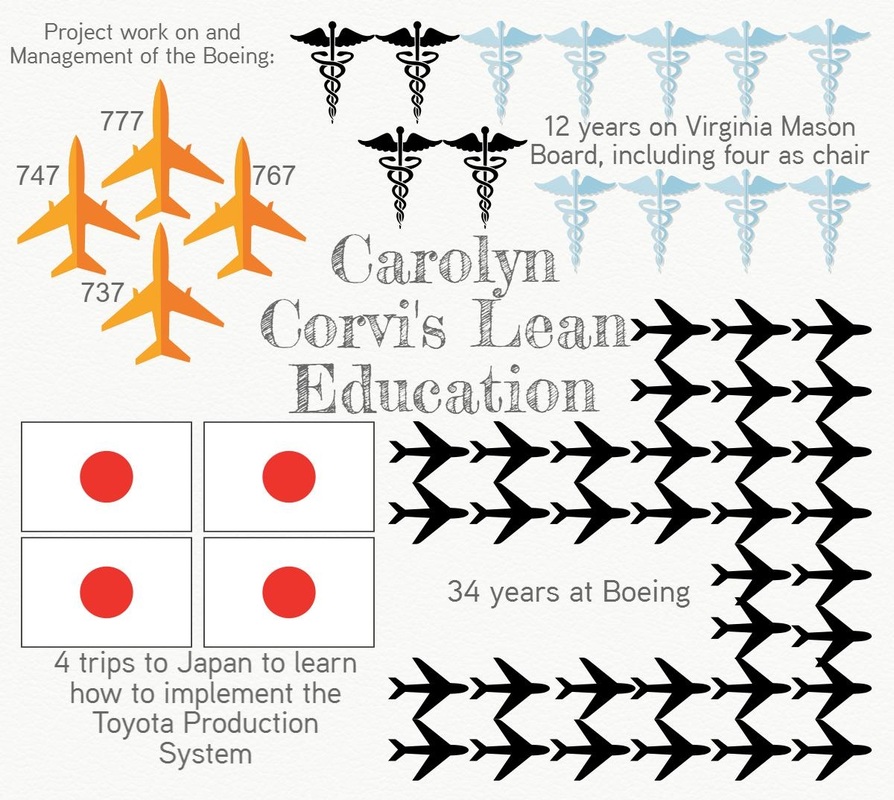
Becoming a Lean leader sure doesn’t happen overnight. Lean leaders transform their listening and team-building skills to usher in eras of far-reaching and continuous improvements. Carolyn Corvi, a true example of Lean Leadership, learned her craft over many years of study and implementation of the Toyota Production System. Here’s a visual look at some of the main ingredients in her education:
Picture
Corvi’s skills are built on years and years of a passion to continuous learning.
 
In my opinion, history will record that Corvi took every piece, every bit, of learning as a Sloan Fellow at MIT and her trips to Japan to study the Toyota Production System and the technical advice of our Shingijutsu Sensei's and made it all happen. It was a brilliant, major breakthrough in the style and thinking of Toyota. Corvi achieved unheard of production gains of 50%, a space reduction of 40%, and a cultural shift to on-site teamwork and persistent communication. Corvi successfully addressed the antiquated separation of mechanics and manufacturing employees who were building the Boeing 373 in batch production. Since serving on the board at VMMC, she has been instrumental in ushering in similar transformations at Virginia Mason, a testament to the depth of her learning and her ability to translate the Toyota Production System’s potential for healthcare.

Lean: Adaptable Transformation

10/21/2016

 
When I first approach healthcare leaders about Lean, I’m often met with skepticism. Sometimes their questions center on a version of the following:
 
How can a system developed for Japanese auto-manufacturing, then advanced by Boeing for American plane manufacturing, possibly have relevant application in healthcare systems worldwide?
 
The connections seem far-fetched at first, but the power of Lean is that it is more than a narrow set of instructions; lean is an adaptable process for effecting organizational transformation regardless of the industry. Lean originated in Japan with the Toyota Production System, but its approach provides a universal roadmap to improvement. To illustrate the dynamic possibilities of lean, let’s look at the career of Carolyn Corvi, who led the adaptation of the Toyota Production System into the Boeing Production System and subsequently led and influenced transformations in the healthcare field.
 
By the 1980s, wasteful practices crept into Boeing’s production line. Leadership at Boeing, including Corvi, looked to Japan’s booming economy for answers.
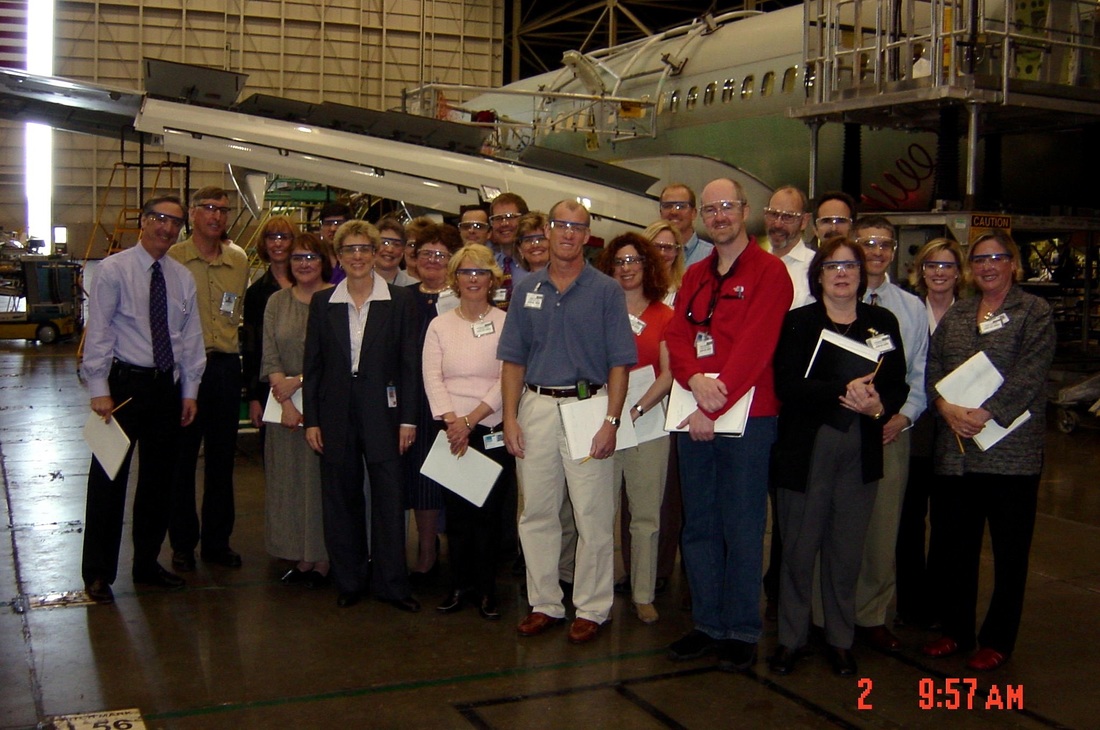
PictureCarolyn Corvi leads a tour of Boeing's 737 production line for executives at Virginia Mason Medical Center. In implementing lean, Corvi learned that the best leaders are teachers.

 
Corvi introduced the concepts of Toyota’s moving line first at Boeing’s Propulsion Systems Division, and later to 737 airplane assembly. A meeting with Sensei Nakao, then President of Shingijutsu Co, LTD, as well as travels to Japan introduced Corvi to the innovative approaches at the Toyota factory. There, leaders acted as coaches, harnessing the full capacity of their workers’ abilities and inspiring their teams to continuously improve. Corvi was impressed with the technical genius of Toyota’s system and immediately saw possibilities for revolutionizing Boeing’s production line.
 
As Corvi adapted the methods of Toyota’s moving line to Boeing’s Propulsion Systems Division, the changes closed the gap between engineers and workers on the ground. This new system required a skillfully guided shift in company culture that revolutionized employee communication and collaboration. Corvi’s work made a significant contribution to Boeing’s reduction of factory cycle time by 46 percent and reduced defects of 90 percent. Boeing’s product quality went up as their costs went down.
​
Boeing’s success adopting and adapting the Toyota Production System (TPS) inspired Corvi to apply lean principles to another industry: healthcare. Just as successful plane manufacturing produces quality, defect-free jets, healthcare facilities’ strive to provide quality, mistake-free care to patients. In 2001, Corvi joined the board at Virginia Mason Medical Center (VMMC) where executive leadership had committed to adopt the Toyota Production System both at the hospital and throughout the entire health system. VMMC leaders visited the Boeing factory and began to learn how to apply TPS to transform employee communication and operations across all levels of patient care. TPS resulted in greater transparency and commitment to continual improvement in the patient care system, both cutting costs and leading to healthier and happier patients.
 
Lean’s applications are truly endless as long as the leadership is committed to seeing the process through. In Corvi’s words, “Lean is not a manufacturing tactic or a cost reduction initiative. It’s a management system that applies to all organizations.  It requires courage, conviction, willingness to take risk and a ‘leap of faith’.” (Corvi 2010).
 
No matter what industry you’re in, I encourage you to set your vision for what your organization can achieve. Chances are you’ve already got the people in place to make your vision a reality, and applying Lean methods will enable the changes needed to make best use of the personnel and facility resources you already have.
 
 
Want to learn more about Corvi's Lean education? Click here.


Sources:
Black, John R. 2008. Lean Production: Implementing a World Class Production System, Industrial Press, Inc.
Black, John R. 2015. The Toyota Way to Healthcare Excellence, 2nd ed. Health Administration Press.
Corvi, Carolyn. Personal interview with John Black. February 15, 2015.
Corvi Carolyn. Presentation to Siemens Corporation. 2010.
Dec 2004/Jan 2005. High Speed Performance, In Boeing Frontiers Magazine, vol 3, issue 8 available online at http://www.boeing.com/news/frontiers/archive/2004/december/i_ca1.html

On Planning for the Next Hundred Years

10/14/2016

 
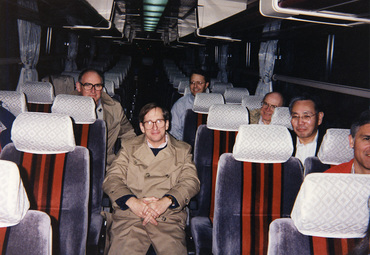
PictureBoeing's first 1990 Japan Study Mission to Toyota.
​On a visit to Japan several years ago, when I was first becoming acquainted with the concepts of Lean Manufacturing, I visited a beautiful 1,200 year old Japanese temple built of wood. It was a great reminder of the Japanese inclination to plan and act with many years of the future in mind, and it symbolized one of the most interesting paradoxes of Lean manufacturing. Lean manufacturing is a philosophy with a goal of continuous improvement over many years, yet it is based on the small acts that make up daily work. At Toyota, where the philosophy of Lean was developed, its practitioners think in terms of 100 years. They are serious when they say their goal is perfection and that after 50 years they are halfway there.
 
This quest for perfection is a way of life. Perfection is achieved by many small improvements made continuously. The simple but startling truth is that focusing on the long term drives us to focus on the present, rather than the past or the future. And the present is where we need to be to replace mental models about people, space, and equipment.
 
The organizations we work to improve today will last through our lifetime and our children’s lifetimes. Lean principles require us to embrace that long-term view and live with the consciousness that what we do today is part of a continually improving process. It is never done.
 
While many American consultants counsel only the big, expensive changes, the Japanese philosophy of Lean is based on small, steady, incremental changes. Instead of grandiose theories or laborious planning, the Lean outlook calls for seizing opportunities to eliminate wasted time, motion, materials, and space right now. As one of the senseis from Shingijutsu Company once said in mild exasperation, “Don’t brainstorm, trystorm! You won’t know if an idea is any good unless you’ve attempted it.”
 
This philosophy centers on the value of people. Part of the Lean vision is the fundamental belief in people and people-building. People must change paradigms. When changes come from the work itself, as instigated by the people who do that work, organizations change naturally. Structures change from hierarchical to flat.
 
When we impose cultural change by imposing great process improvements from the top, we are working counter to Lean philosophy. Recreating the foundation from the bottom, through continuous improvement, will result in an improved company that will last. But first must come a new way of looking at work—as part of a great continuum.
 
If thinking in terms of decades and centuries seems overwhelming, consider this: I learned from my time at Boeing that the working life of an individual employee was shorter than the products we were selling. Those who designed the 707 were no longer with us by the time I worked there. To succeed, we must remember that improvement is incremental and continuous, and so are the rewards.

Forward>>
    Picture

    About the author
    ​

    John Black, President and CEO of JBA, has implemented Lean improvements for four decades, first with the Boeing Company and later as a leading consultant in the healthcare industry.


      Get monthly blog updates in your inbox

    Subscribe

    Categories

    All
    Human Potential
    Innovation
    Lean History
    Lean Leaders
    Organizational Design
    Patient Focus
    Process
    Vietnam
    World-class
    Zero Defects


    Archives

    January 2018
    November 2017
    October 2017
    July 2017
    June 2017
    May 2017
    April 2017
    March 2017
    February 2017
    January 2017
    December 2016
    November 2016
    October 2016

    RSS Feed

©2015 John Black and Associates